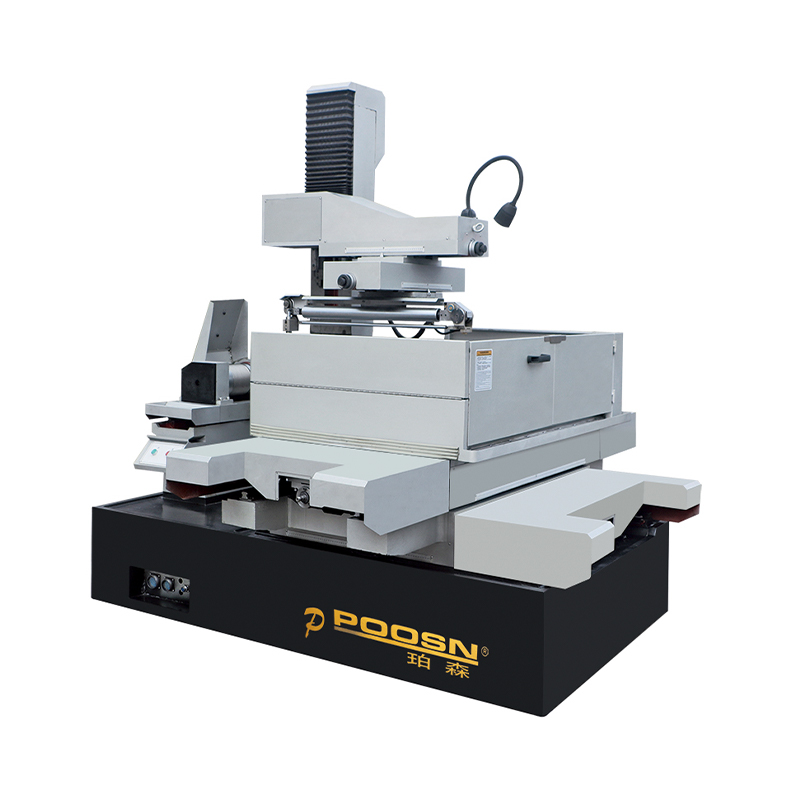
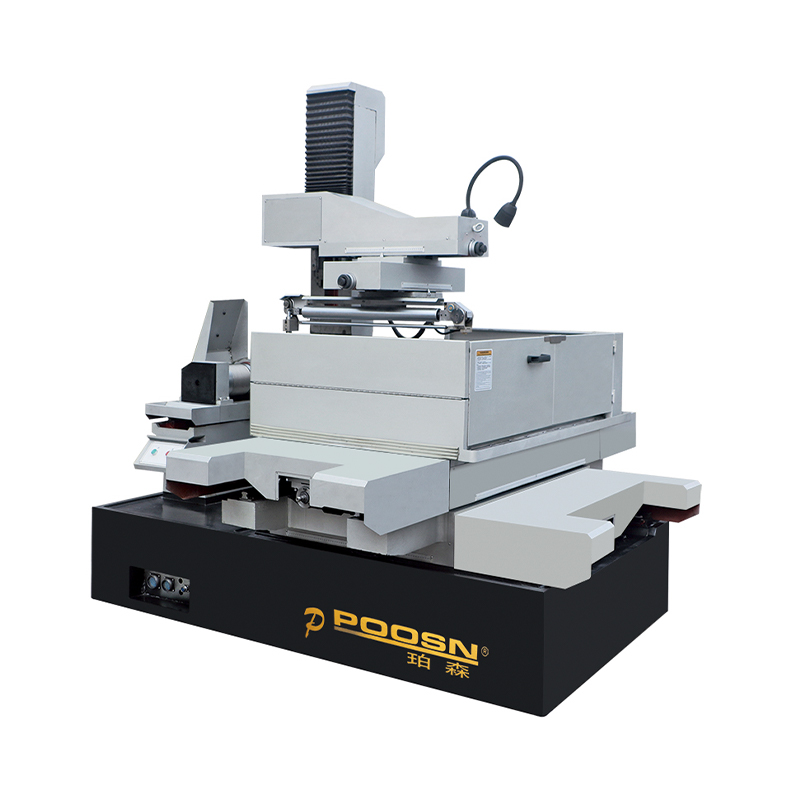
Wire EDM works by using a continuously fed, electrically charged thin wire to erode conductive material through a series of rapid, controlled electrical sparks — with no physical contact between the wire and the workpiece. This non-contact erosion process allows a CNC wire EDM machine to cut through hardened steel, carbide, titanium, Inconel, and other difficult materials with tolerances as tight as ±0.002 mm, producing complex profiles, sharp internal corners, and taper angles that are impossible to achieve with conventional rotary cutting tools. The process is governed entirely by the CNC controller, which coordinates wire position, feed rate, discharge energy, and flushing parameters in real time, making every cut repeatable and programmable. Whether you are running a precision mold wire EDM application, producing aerospace brackets, or cutting punch dies in hardened tool steel, understanding how this electrical discharge machining machine operates is the first step to unlocking its full potential for your production environment.
The core physics of wire EDM has remained consistent since the technology was developed, but modern CNC WEDM machines have transformed it into a highly automated, high-accuracy process. Advanced servo wire EDM control systems, precision wire guides, optimized pulse generators, and multi-cut firmware work together to deliver surface finishes and dimensional accuracy that were previously achievable only with grinding. This article explains the working principle step by step, compares the main machine types available from wire EDM manufacturers today, and provides practical guidance on selecting the right industrial wire EDM machine for your specific application.
The horizontal bar chart above summarizes key performance metrics of wire EDM relative to conventional CNC machining, scored out of 10. The most striking advantage is the complete absence of tool wear (10/10): because the electrode wire is continuously fed and never contacts the workpiece mechanically, there is no progressive deterioration of the cutting edge that would otherwise cause dimensional drift in milled or turned parts. Dimensional accuracy scores 9.5/10, reflecting the capability of modern CNC wire EDM machines to hold tolerances of ±0.002–0.003 mm consistently across long production runs. Complex profile capability (9.2/10) highlights the machine's ability to cut any 2D contour, including sharp internal corners with radii limited only by the wire diameter, under full CNC control. Material versatility (9.0/10) confirms that wire EDM for carbide, hardened steel, titanium, and Inconel are all practical applications — the spark erosion mechanism is hardness-independent. Surface finish quality (8.5/10) reflects the substantial improvement achievable through multi-cut strategies on medium-speed wire EDM machines. Automation (8/10) acknowledges that modern servo wire EDM systems with automatic wire threading can run unattended for extended periods, reducing direct labor costs significantly.
The Step-by-Step Working Principle of Wire EDM
Understanding how an electrical discharge machining machine operates requires examining each functional stage of the process. While the sequence appears straightforward, each step involves sophisticated engineering — from pulse generator design to dielectric fluid chemistry — that collectively determines the accuracy, speed, and surface quality of the finished part.
Step 1: Wire Setup and Threading
The process begins by threading a thin electrode wire — typically 0.1 mm to 0.25 mm in diameter — through precision upper and lower wire guides that are mounted on the machine's CNC-controlled axes. In high-speed wire EDM (molybdenum wire EDM), the wire is wound between two spools and recirculated repeatedly. In medium-speed CNC wire EDM machines such as the PS-C series, the wire tension, guide geometry, and wire path are optimized with finer tolerances to support multi-cut trim operations. Correct wire tension is critical: insufficient tension causes wire vibration and dimensional error, while excessive tension risks wire breakage and production downtime.
Step 2: Workpiece Clamping and Reference Setting
The conductive workpiece is secured to the machine table using precision clamps or magnetic chucks. The CNC controller then references the workpiece coordinate system by probing the part surface or locating a datum hole. Accurate workpiece datum setup is one of the most important operator skills in wire EDM, as any misalignment here propagates directly into the finished part. Industrial wire EDM machines typically offer automatic edge-finding and center-finding cycles to minimize setup time and human error.
Step 3: Dielectric Fluid Flooding
Before cutting begins, the machining zone is flooded with dielectric fluid — deionized water in most wire cutting machines. This fluid serves three essential functions: it acts as an electrical insulator between discharge pulses, preventing premature arcing; it carries away eroded material particles from the spark gap; and it cools the wire and workpiece to prevent thermal distortion. The conductivity of the deionized water is carefully monitored and controlled, as changes in conductivity directly affect spark stability and surface finish quality.
Step 4: Electrical Discharge Erosion
With the wire positioned at a precisely controlled gap (typically 0.01–0.05 mm) from the workpiece surface, the pulse generator applies a series of high-frequency voltage pulses — commonly in the range of 50 kHz to several hundred kHz. Each pulse creates a plasma channel through the dielectric, reaching temperatures of approximately 8,000–12,000°C in the spark zone. This temperature vaporizes a microscopic crater of workpiece material approximately 1–5 µm deep per spark. At thousands of sparks per second, material removal proceeds at practical cutting speeds while maintaining the microscopic precision characteristic of EDM wire cutting machines. The servo feed system continuously monitors gap voltage and adjusts the table feed rate to maintain optimum discharge conditions — this is the servo wire EDM principle that distinguishes precision industrial machines from simpler designs.
Step 5: CNC Axis Control and Profile Generation
While the discharge erodes material, the CNC controller simultaneously drives the X and Y axes to trace the programmed contour. On machines equipped with U-V axis control — including large taper wire EDM machines and the PS-C series — the upper wire guide can be independently positioned relative to the lower guide, allowing the wire to be angled in space. This enables the production of tapered profiles, compound angles, and large-angle wire EDM cuts up to ±30° or ±60° on specialized taper wire EDM machines like the DK77-D series. The result is a precision contour cut through the full thickness of the workpiece in a single CNC program, without any tool change or secondary setup.
Step 6: Multi-Cut Finishing (Medium-Speed EDM)
After the roughing cut establishes the basic profile, medium-speed wire EDM machines execute one or more trim passes at reduced discharge energy and a slight offset from the rough profile. Each trim cut removes only a few microns of material, progressively improving surface finish and dimensional accuracy. The PS-C series medium-speed wire EDM machines achieve Ra surface roughness values below 0.8 µm after multi-cut processing, making them directly competitive with surface grinding for many mold and die applications. High-speed wire EDM (DK77-A, DK77-B series) completes cutting in fewer passes, making it more economical for general-purpose and volume applications where Ra 1.5–3.5 µm is acceptable.
How Discharge Energy Shapes Cut Quality: The Pulse Generator's Role
The pulse generator is the electrical heart of every wire cutting machine. It controls on-time (pulse duration), off-time (interval between pulses), peak current, and voltage — four parameters that together determine material removal rate, surface finish, and wire stability. Understanding how these variables interact helps operators and engineers select the right machine settings for each material and application.
The 3D column chart illustrates how three different pulse parameter regimes affect material removal rate, surface finish quality, and wire stability — the three outputs that most directly determine whether a wire cut EDM machine produces acceptable parts efficiently. Under high on-time (roughing) settings, the material removal rate peaks at 9/10, making this configuration ideal for the initial cut through thick workpieces or when cutting time is the overriding constraint. However, surface finish drops to just 2/10 and wire stability suffers (4/10) because the larger spark energy causes more violent plasma formation, creating wire vibration and larger recast layers on the cut surface. Low on-time (finishing) settings reverse this relationship: surface finish quality rises to 9.5/10 and wire stability improves to 9/10 as the gentler pulses produce finer craters and more controlled erosion, but material removal rate falls to 3/10, making this unsuitable as a stand-alone strategy for thick stock. The servo-optimized setting — the operating mode used by the PS-C series medium-speed wire EDM and advanced CNC WEDM machines — achieves a practical balance: material removal rate of 7/10, surface finish of 8/10, and wire stability of 9/10. This balance is maintained dynamically by the servo feedback loop, which continuously reads gap voltage and adjusts both feed rate and discharge parameters, preventing the instability that would result from either extreme while sustaining commercially viable cutting productivity.
In practice, advanced CNC cutting equipment achieves this balance through a multi-stage cutting strategy rather than a single parameter set. The roughing pass maximizes material removal rate. Each subsequent trim cut applies progressively lower discharge energy, stepping surface finish down from Ra 3.0 µm to Ra 1.0 µm to Ra 0.6 µm or better. This staged approach is the defining capability of multi-cut wire EDM technology, and it is what separates a precision medium-speed EDM machine from a basic high-speed wire EDM in demanding applications.
Wire EDM Machine Types and Their Working Mechanisms
Not all wire EDM machines work in exactly the same way. The electrode wire type, wire motion system, pulse generator design, and CNC control architecture differ significantly between machine categories, and these differences have direct practical implications for the parts you can produce and the quality you can achieve. Below are the principal machine types available from wire EDM manufacturers today, along with their working characteristics.
In high-speed WEDM — also called fast wire EDM or reciprocating wire EDM — the electrode wire is wound between two storage cylinders and moves back and forth at wire speeds of 8–12 m/s. Molybdenum wire (0.18 mm diameter) is standard because it withstands the repeated thermal cycling of reuse without failing as rapidly as brass wire would. The DK77 series from Taizhou Xinchengyang — including DK7735, DK7745, and DK7763 — exemplifies this category. Cutting speed in mild steel reaches up to 180 mm²/min, making the DK77 an economic wire EDM machine well suited to general die parts, structural profiles, and educational applications. Surface roughness in a single pass is Ra 1.5–3.5 µm, which is adequate for rough tooling but insufficient for precision mold cavities.
Medium-Speed Wire EDM (Multi-Cut CNC WEDM)
Medium-speed wire EDM machines combine the low wire-consumption benefit of reciprocating wire systems with multi-cut capability and finer pulse control. The PS-C series — models PS35C, PS45C, PS50C, and PS60C — represents this category. The servo wire EDM control architecture monitors gap voltage in real time and adapts feed rate and discharge energy dynamically, enabling stable multi-cut trim passes that progressively refine the surface. After four to five trim passes, the PS-C series achieves Ra values below 0.8 µm and positional accuracy better than ±0.003 mm, meeting the demands of precision mold wire EDM, wire EDM for aerospace, and wire EDM for medical components. The PS-C series is specifically designed for high-precision parts processing, precision mold manufacturing, and aerospace component processing — three application domains where consistent sub-micron surface quality determines product acceptance.
Large Taper Wire EDM (DK77-D Series)
Large taper wire EDM machines add independent U-V axis control to the standard X-Y table, enabling the upper wire guide to be offset relative to the lower guide. This creates an angular wire position, allowing the machine to cut tapered profiles in a single pass. The DK77-D series supports 30-degree taper wire EDM and 60-degree taper wire EDM configurations, enabling wire EDM for punch die applications with steep angular clearance faces, extrusion die profiles, and turbine blade root slots. Without this large-angle wire EDM capability, producing such tapers would require multiple setups or alternative processes, significantly increasing lead time and cost.
Table 1: Working Mechanism Comparison Across Wire EDM Machine Types
Machine Type
Wire Motion
Multi-Cut
Taper Axes
Best For
DK77-A / DK77-B (High Speed)
Reciprocating (8–12 m/s)
Limited
±6°
General tooling, education, high-volume rough cutting
How Wire EDM Achieves Precision: The Role of Servo Control and Gap Monitoring
The precision of a CNC wire EDM machine is not simply a function of its mechanical rigidity, although that matters. It is primarily a function of how accurately and quickly the servo system responds to changes in the discharge gap. If the wire advances too quickly, it contacts the workpiece and short-circuits, halting productive cutting. If it advances too slowly, the gap widens, discharges become inconsistent, and surface quality degrades. The servo wire EDM control system solves this by measuring gap voltage hundreds of times per second and adjusting the table feed rate continuously to maintain the optimum discharge gap.
Modern industrial wire EDM equipment combines this gap-voltage servo with additional enhancements: adaptive pulse control that adjusts on-time and peak current in response to detected arc conditions; automatic corner-compensation algorithms that slow the feed rate at sharp corners to prevent overcut; and wire-breakage detection that immediately halts the machine and alerts the operator. Together, these features allow a precision wire EDM machine to run unattended through long programs, producing consistent part quality from the first cut to the last.
The line chart demonstrates the servo response behavior that is central to how a precision CNC wire EDM machine maintains cut quality. During normal straight-line cutting (T0 to T1), gap voltage holds steady at approximately 75–80% of nominal and feed rate runs near 100% of the programmed value — the discharge is stable and material removal is consistent. As the wire approaches a sharp internal corner (T1 to T2), the effective cutting front area decreases, causing the gap to tighten and gap voltage to drop toward the short-circuit threshold. The servo system detects this change and automatically reduces feed rate, slowing the table to allow the discharge energy to clear the gap and prevent wire contact with the workpiece. At the corner event (T2), gap voltage dips further and feed rate may temporarily reduce to 40–50%, after which the servo system detects gap recovery and progressively restores feed rate (T2 to T3) as cutting returns to normal straight-line conditions. By T3 and beyond, the system has stabilized and normal high-speed cutting resumes. This automatic adaptive response — executed hundreds of times per second by the servo controller — is what allows high accuracy wire EDM machines to maintain dimensional fidelity through complex contours without operator intervention, and it is a key differentiator between industrial-grade CNC WEDM machines and simpler open-loop designs.
Application-Specific Considerations: Matching the Process to the Part
Wire EDM's working principle makes it uniquely suited to specific manufacturing scenarios. Understanding where the process excels — and where alternative methods may be preferable — helps engineers and procurement teams make informed decisions when evaluating wire EDM suppliers and machine types.
Wire EDM for Mold Making and Die Manufacturing
Wire EDM for mold making is one of the most established applications for the technology. Injection mold cores and cavities, stamping dies, blanking dies, and progressive die inserts all require precise contours in hardened tool steels. Because wire EDM cuts hardened material without inducing residual stress or mechanical distortion, parts can be fully heat-treated before the final EDM operation, eliminating the dimensional changes that result from heat treatment after machining. The PS-C series medium-speed wire EDM machines are particularly well suited to wire EDM for die manufacturing, combining multi-cut surface quality with the table sizes (up to 900 mm on the PS60C) needed for large die sets.
Wire EDM for Aerospace and Automotive Parts
Wire EDM for aerospace applications covers turbine blade attachment features, structural brackets, fuel system components, and actuation hardware — all of which may be manufactured from titanium, Inconel, or other high-temperature alloys. Wire EDM for titanium and wire EDM for Inconel are especially practical because spark erosion cuts these materials at controlled rates without the work-hardening and tool-wear issues that afflict milling. Wire EDM for automotive parts includes transmission components, sensor housings, and EV motor lamination tooling, where dimensional precision in hardened materials directly determines component performance and assembly quality.
Wire EDM for Medical Components and Precision Parts
Wire EDM for medical components demands not only tight tolerances but also excellent surface integrity. Implants and surgical instruments must meet strict surface-finish requirements to avoid stress concentration, bacterial adhesion, or biocompatibility issues. The medium-speed wire EDM process, with its progressive multi-cut surface refinement, achieves Ra values suitable for medical-grade surfaces without the risk of mechanical surface damage from grinding. Wire EDM for precision parts more broadly — including instrument components, micro-electromechanical parts, and semiconductor tooling — similarly benefits from the process's ability to produce features at any orientation in a single setup, with no tool-change delay.
The radar chart maps application suitability scores across six manufacturing domains for both the PS-C medium-speed series and the DK77 high-speed series. The PS-C series dominates mold and die (9.5/10), aerospace (9/10), and medical (9.5/10) applications — precisely the domains where multi-cut surface refinement and tight dimensional tolerances determine product acceptability. Its carbide-tooling score of 9/10 reflects the ability of medium-speed servo EDM to cut tungsten carbide cleanly, producing the burr-free edges that carbide die inserts require. The DK77 high-speed series scores highest in prototyping (9/10) and matches the PS-C in automotive applications (8/10), making it the rational economic choice for fast-turnaround parts, student training programs, and production runs where Ra 2–3 µm is acceptable. The overlap in automotive confirms that both machine families serve this sector well, with the choice depending on whether the specific part requires precision mold-grade finishing or general structural-grade cutting. This radar visualization makes machine selection straightforward: identify the two or three application domains most important to your production environment, and select the machine series that performs most strongly in those specific areas rather than comparing headline specifications in isolation.
About Taizhou Xinchengyang Machinery Manufacturing Co., Ltd.
Taizhou Xinchengyang Machinery Manufacturing Co., Ltd. is a dedicated wire EDM manufacturer with deep expertise in the research, development, and production of electrical discharge machining equipment and related special processing technologies. The company brings together strong technical capabilities, advanced processing equipment, comprehensive testing methods, and rational product design, all underpinned by a quality management system that mandates positioning accuracy testing for every machine before shipment. This pre-delivery accuracy verification ensures that every industrial wire EDM machine leaving the factory meets the specifications that customers rely on for their production planning — not just benchmark units tested under ideal conditions.
The company's product portfolio covers the full spectrum of wire EDM technology. The PS-C and DK77-BC series deliver medium-speed multi-cut capability for precision mold wire EDM and high-accuracy die manufacturing. The DK77-A and DK77-B series high-speed wire EDM machines serve cost-conscious applications requiring fast cycle times and economic operation. The DK77-D series large taper wire EDM machines extend the company's reach into complex die-clearance and taper-profile applications up to ±60°.
Products are distributed across China's domestic manufacturing sector, with select models exported to Southeast Asia, West Asia, Europe, and the Americas. Operating under the guiding principle of "Quality First, Customer Supreme," Taizhou Xinchengyang combines market orientation with a genuine commitment to fulfilling user needs — providing buyers with a reliable wire EDM factory partner that delivers consistent quality, responsive technical support, and a product range designed to grow with their manufacturing requirements.
Frequently Asked Questions
Q1. Does the wire physically touch the workpiece during wire EDM cutting?
No. Wire EDM is a non-contact process. The electrode wire is maintained at a controlled gap of 0.01–0.05 mm from the workpiece surface, and material removal occurs entirely through electrical spark erosion across this gap. Physical contact would cause a short circuit that the servo system immediately detects and corrects by retracting the wire.
Q2. What dielectric fluid is used in wire EDM machines?
Most wire cutting machines use deionized water as the dielectric fluid. The water is continuously filtered and its conductivity is monitored to maintain stable discharge conditions. Deionized water provides effective cooling, efficient debris flushing, and safe operating conditions compared to oil-based dielectrics used in some other EDM processes.
Q3. Can wire EDM cut non-metallic materials?
Wire EDM requires the workpiece to be electrically conductive. Standard non-metallic materials such as plastics, glass, and ceramics cannot be cut directly. However, conductive composites such as PCD (polycrystalline diamond with conductive binder), PCBN, and certain conductive ceramic grades are processable. For non-conductive materials, laser cutting or abrasive waterjet are typically more appropriate choices.
Q4. What is the difference between multi-cut wire EDM and single-cut wire EDM?
Single-cut wire EDM completes the profile in one pass at full discharge energy, producing Ra 1.5–3.5 µm surface finish and moderate dimensional accuracy. Multi-cut wire EDM adds one or more trim passes at progressively reduced discharge energy and a slight kerf offset, improving surface finish to Ra 0.4–0.8 µm and tightening dimensional accuracy to ±0.002–0.003 mm. The PS-C series medium-speed CNC wire EDM machines support full multi-cut processing as a standard feature.
Q5. How does wire EDM handle sharp internal corners?
Wire EDM can produce internal corner radii as small as the wire radius plus the discharge gap — typically 0.10–0.15 mm for standard 0.18 mm wire. The CNC controller applies corner-compensation algorithms that automatically slow the feed rate at corners to prevent overcut from discharge lag. For very sharp corners in precision mold wire EDM, a secondary EDM pass with a smaller diameter wire can further reduce the corner radius to below 0.08 mm.
Q6. What wire diameter is used in molybdenum wire EDM machines?
High-speed WEDM machines (DK77 series) most commonly use 0.18 mm diameter molybdenum wire, which offers a practical balance of tensile strength, conductivity, and kerf width for general-purpose cutting. Medium-speed machines like the PS-C series also support 0.18–0.20 mm wire for roughing and trim cuts. Smaller wire diameters (down to 0.10 mm) are available for fine-feature applications but require machines with precision wire-guide systems designed to handle the reduced wire stiffness.